 Keycap
Blog · 3 min read ·
The key pairs that slow you down
Most lost typing speed hides in a few two-key sequences, not in single keys. Here is why pairs matter, which ones are hardest, and how to find yours.
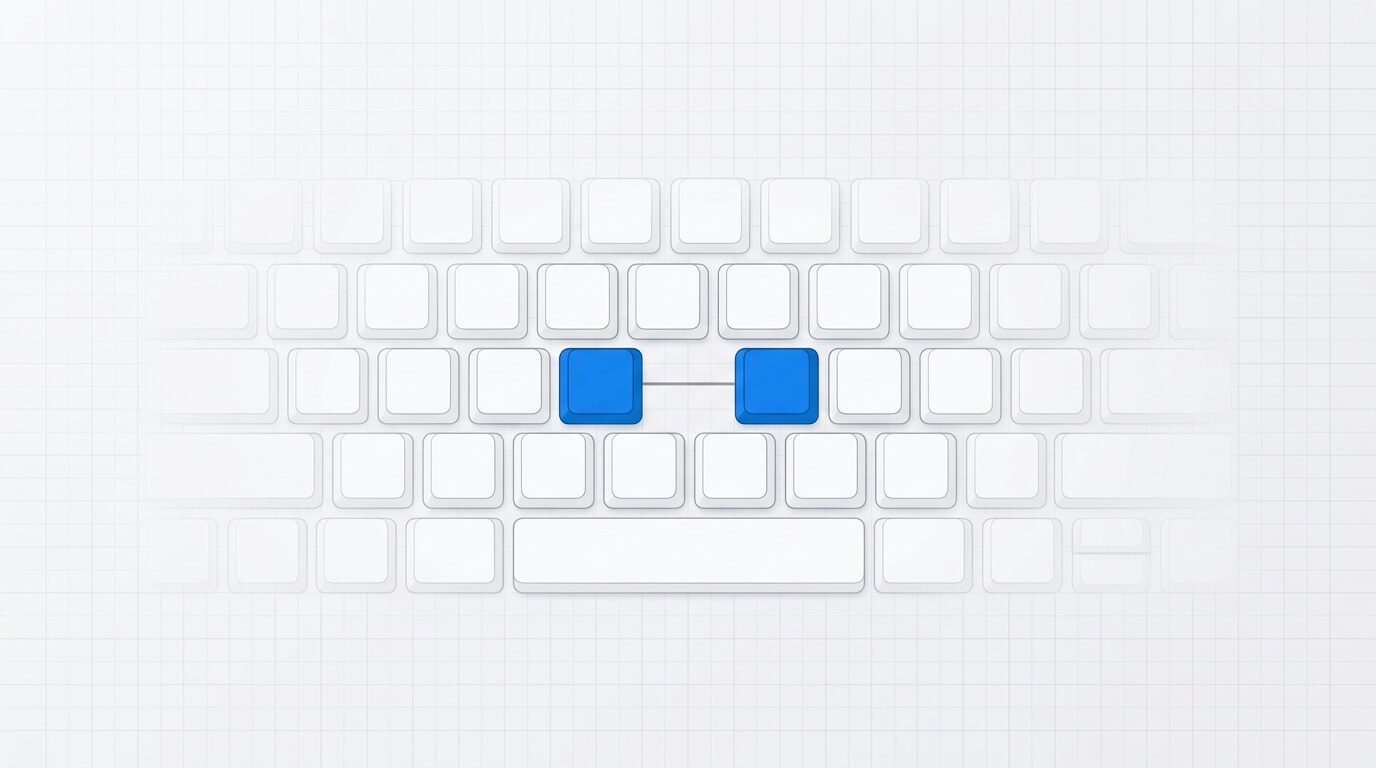
When a typist plateaus, the problem is rarely a key. It is a pair: two keys typed in sequence where the move from the first to the second is awkward. You can be fast on e and fast on d and still stall on ed, because the same finger has to type both.
Why pairs are the unit that matters
Typing speed is the speed of transitions. A single key is a reach; a pair is a reach followed by another reach, and the second one starts from wherever the first one left your hand. Some sequences flow: alternating hands, adjacent fingers rolling inward. Others fight you: the same finger twice, a pinky stretch followed by an index reach, a hand crossing over itself.
English is full of both. th, he, in, er, an are the most common pairs in the language, and they are mostly comfortable, which is one reason fluent typists look effortless. The uncomfortable ones are rarer, and that rarity is the trap: they come up too seldom in ordinary text to get practised, so they stay slow for years.
The pairs most people find hard
- Same-finger pairs.
ed,de,un,nu,ki,lo,ce. The finger has to strike, lift, travel and strike again. - Pinky pairs. Anything involving
q,z,p,;,/and the quote. The weakest finger, the longest reach. - Bottom-row pairs.
xc,vb,nm,,.. Reaching down feels less certain than reaching up. - Shifted pairs. A capital followed by a letter on the same hand, when Shift was held with the wrong pinky.
Yours will be different. That is the point.
Finding your pairs
You cannot feel which pairs are slow; they all feel slow when you stall. You need a record. A trainer that logs every keystroke during a run can compute, for each two-key sequence, how often you got it right and how long it took, and rank them. The top of that list is where your next month of improvement is.
A trainer that does this will choose drill words because they contain the pair, which puts it in front of you dozens of times in a minute instead of once, and will tell you when the pair has stopped costing you. (Keycap's Fix works this way, three pairs at a time.)
Drilling a pair
Type words that contain it, slowly, until the transition stops needing thought. Then type them at speed. Then go back to ordinary text and see whether it holds. Three pairs at a time is about the limit; more than that and the practice loses focus. When a pair is fixed, stop drilling it. Practice spent on what you already do well is practice not spent on what you don't.
Common questions
What is a bigram in typing?
A bigram is a two-key sequence, such as "th" or "ed". In typing practice they matter because speed is lost in the move between two keys more than on either key alone.
Which letter combinations are hardest to type?
Sequences typed by the same finger, such as "ed" and "un", and anything involving the pinkies. Which ones are hardest for you depends on your own habits, which is why a per-pair record is more useful than a general list.
How do I get faster at specific letter combinations?
Drill words that contain the combination, slowly at first, a few combinations at a time, and measure before and after so you know when to stop.