 Keycap
Blog · 3 min read ·
The home row, and which finger owns which key
The home row is A S D F and J K L ;. Every key on the keyboard belongs to one finger, reached from there. Here is the full map for an ANSI (US) Mac keyboard.
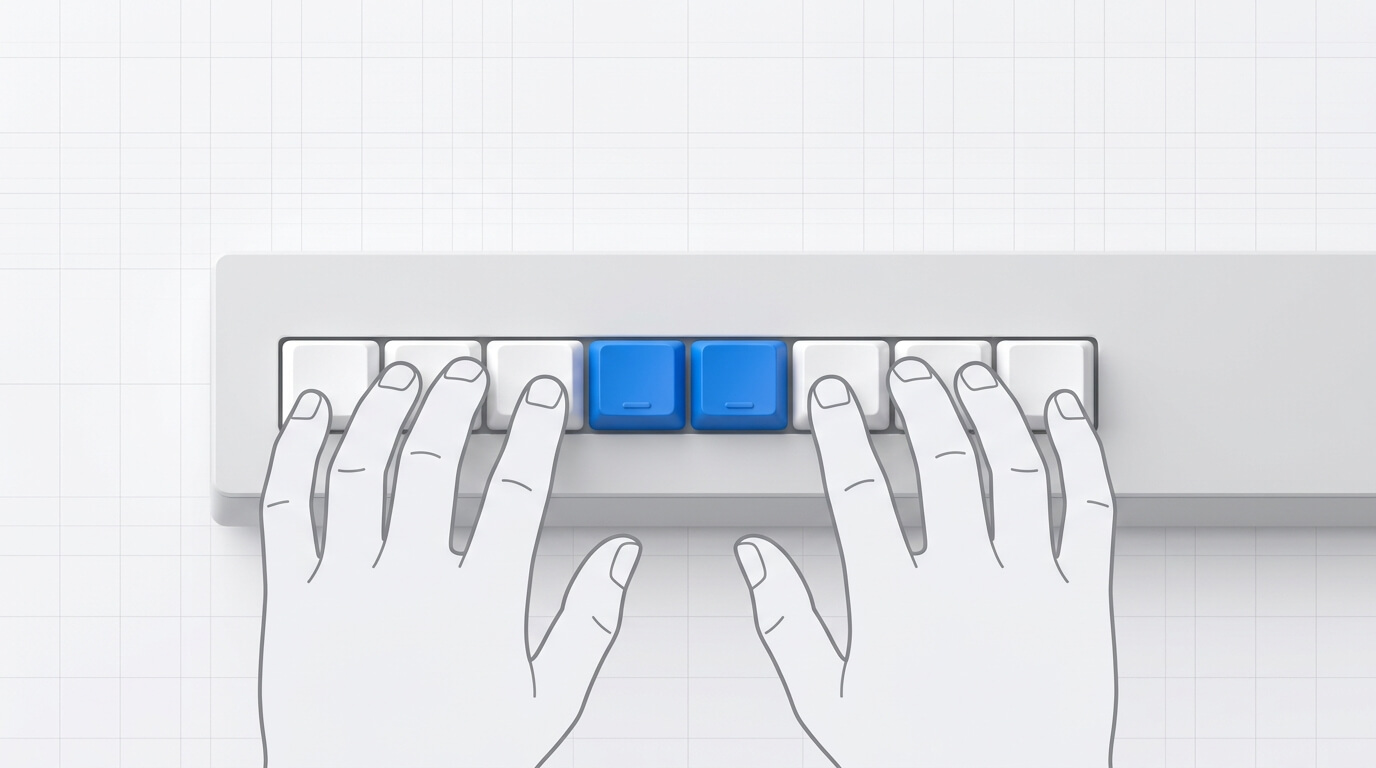
The home row is where your fingers rest between keystrokes: A S D F under the left hand, J K L ; under the right. Every other key is assigned to the finger directly below it in that row. Learn the assignments once and you never have to decide which finger to use again.
Finding it without looking
The F and J keys on a Mac keyboard have a small raised bar. Rest your index fingers on those and the rest of your fingers fall onto the row. Thumbs go on the space bar. Whenever you lose your place, feel for the bars.
The map
| Finger | Home key | Also owns |
|---|---|---|
| Left pinky | A | Q, Z, 1, Tab, Caps Lock, left Shift |
| Left ring | S | W, X, 2 |
| Left middle | D | E, C, 3 |
| Left index | F | R, T, V, B, G, 4, 5 |
| Right index | J | U, Y, M, N, H, 6, 7 |
| Right middle | K | I, comma, 8 |
| Right ring | L | O, full stop, 9 |
| Right pinky | ; | P, slash, 0, hyphen, equals, brackets, quote, Return, right Shift |
| Thumbs | Space |
The index fingers do the most work: each one covers two columns. The pinkies travel furthest and are weakest, which is why Q, P, Z and the punctuation to the right of L are the keys most typists are slowest on.
Shift is the other hand's job
To type a capital, hold Shift with the pinky of the hand that is not typing the letter. Capital A is left pinky on A with the right pinky on Shift. Capital P is the reverse. Using the same hand for both twists the wrist and is what makes capitals slow.
The reaches
A reach is a move from the home key to another key and back. The return matters as much as the strike. Leaving a finger up on E after typing it means the next D comes from the wrong place. Strike, and be back on the home key before you think about the next letter.
The bottom row is the one people look at, because reaching down feels less certain than reaching up. The finger assignments are the same as the row above, one step lower: the left index that owns R and T also owns V and B.
Why one finger per key
It would be faster, on any single word, to use whichever finger is nearest. It is slower over a lifetime, because a key reached from three different fingers never becomes automatic. Fixed assignments turn every key into one repeated movement, and repeated movements are what your hands can do without thought.
Common questions
What are the home row keys?
A, S, D, F for the left hand and J, K, L, semicolon for the right. Index fingers rest on F and J, which have raised bars so you can find them by touch.
Which finger types the B key?
The left index finger. B sits below G, and the left index owns the F, G, R, T, V and B column pair.
Which finger presses the space bar?
Either thumb. Most people use the thumb of whichever hand did not type the previous letter, without deciding to.